


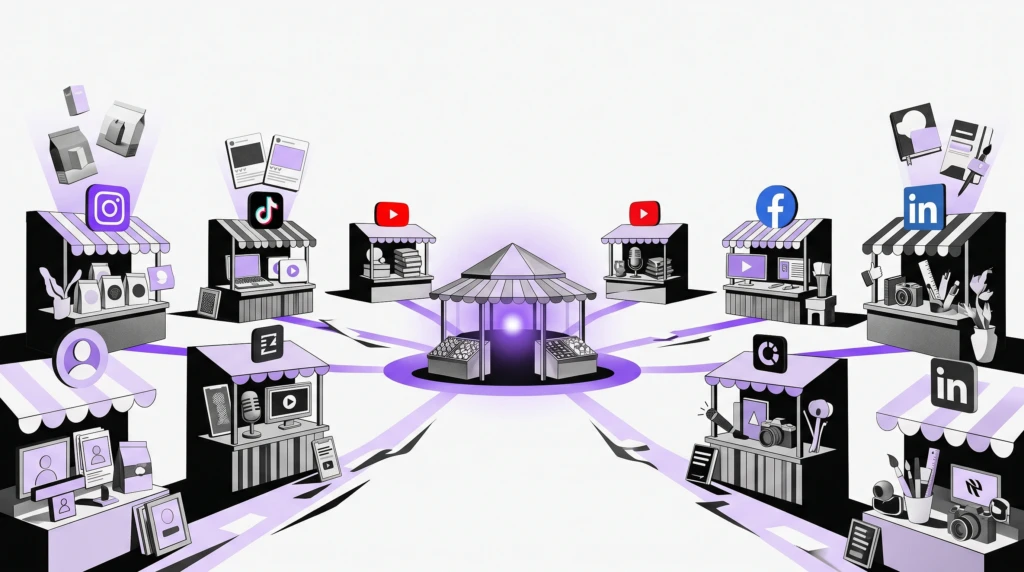
Social media in 2026 is operating at a scale most marketers underestimated. There are now 5.66 billion social media users worldwide, meaning users outnumber non-users nearly two to one globally. At that scale, the platform shifts happening right now are not niche signals. They are category-wide structural changes that affect every brand, creator, and marketer working online.
The defining shift this year is from broadcasting to belonging. Audiences are no longer passive recipients of content. They use social platforms as search engines, shopping destinations, and community spaces simultaneously. A single piece of content now has to serve discovery, trust-building, and conversion in one move. The eight social media trends documented in this article reflect that structural change, grounded in data from Sprout Social, Hootsuite, eMarketer, Deloitte, and Adobe.
Trend 1: Video Dominates every major platform, including LinkedIn
Video is the primary content format on every major social platform in 2026. TikTok, Instagram Reels, YouTube Shorts, and now LinkedIn and Threads have all made video their core distribution priority. Short-form video drives audience acquisition, but long-form video retains it.
The format boundaries between platforms have expanded considerably. Instagram Reels now supports videos up to 20 minutes long as of 2026. TikTok videos run from three seconds to ten minutes. YouTube Shorts maxes out at three minutes. Each platform still rewards platform-native behavior, so a Reel that performs on Instagram will not automatically work on YouTube Shorts without reediting.
LinkedIn’s video engagement has grown 34% compared to 2025, a figure that would have been difficult to predict when the platform was still dominated by text posts and thought-leadership articles. Brands and creators who built audiences on LinkedIn through long-form written content are now pivoting to video-first formats.
YouTube’s position is particularly significant. Per the 2025 Sprout Social Index, YouTube ranks in the top three platforms by profile ownership globally. The 2025 Impact of Social Media Report found that 68% of marketing leaders say YouTube drives the most business impact of any single platform. Benchmark your own video performance using the frameworks in our Data & Analytics hub.
The practical implication for content teams is that platform-specific video production is now table stakes, not a premium differentiator. Creating one video and posting it identically across platforms produces diminishing returns. The brands pulling ahead are producing original video tailored to each platform’s user behavior.
Trend 2: Social Commerce turns into a Primary Sales Channel
Social commerce in 2026 has crossed from supplemental to structural. The global social commerce market stands at $2.6 trillion this year, with the US market alone valued at $126.6 billion, according to SellersCommerce research. That market is projected to grow at a compound annual growth rate of 26.2%, reaching $8.5 trillion by 2030.
TikTok Shop is the fastest-growing commerce platform in the US, with projected ecommerce sales of $23.41 billion in 2026. That figure would place TikTok Shop ahead of Target, Costco, Best Buy, and Kroger in US ecommerce, per eMarketer projections. TikTok Shop’s conversion rate is 4.7%, compared to Instagram Shopping at 2.1% and Facebook Shops at 1.8%.
US Social Commerce Platform Comparison (2026)
| Platform | 2026 US Ecommerce Sales | Conversion Rate | Key Demographic |
| TikTok Shop | $23.41 billion | 4.7% | Gen Z, Millennials |
| Instagram Shopping | Growing | 2.1% | Millennials, Gen Z |
| Facebook Shops | Largest buyer base | 1.8% | Broad, 35+ |
| Pinterest Shopping | Niche-driven | Not published | Women 25-44 |
The trust paradox in social commerce is real and measurable. eMarketer data shows 26% of US consumers say they do not trust influencer marketing, which is 2.4 times the 11% who distrust general advertising. Despite that, 58% of adults over 18 have made a purchase because of an influencer endorsement. Consumers flag influencer content as less credible, then buy from it anyway because product discovery happens there first.
Gen Z is driving this shift most aggressively. Per Sprout Social’s 2026 Content Strategy Report, 49% of Gen Z consumers use TikTok specifically to find their next purchase. Among Gen Zers, 73% say social media is their primary source for learning about new products.
Livestream commerce is the next development in this trend, though adoption is uneven globally. Only 18% of US consumers have shopped via livestream, compared to 60% of Indonesian online buyers who already purchase through live sessions regularly, per Bain, Google, and Temasek research.
Trend 3: AI-Generated Content becomes standard, not experimental
AI content tools crossed from experimental to standard workflow in 2026. According to Adobe’s Digital Trends 2026 report, roughly 87% of marketers used generative AI in at least one recurring workflow in Q1 2026, up from 51% in Q1 2024. That 36-point increase in two years is the fastest adoption curve of any marketing technology category in recent history. If you’re building AI into your social workflow, here are the eight tools worth evaluating.
Businesses are planning to use generative AI for an average of 48% of their social media content by the end of 2026, according to Capterra’s GenAI for Social Content Survey of over 1,600 social media marketers worldwide. That is up from 39% in 2024.
AI agents are the next phase of this trend. These tools are moving past simple content generation into executing complete social media workflows. They manage community interactions, schedule posts, respond to comments, and coordinate multi-step campaign tasks autonomously. This allows teams to maintain operational presence at a scale that was not previously possible with human headcount.
The disclosure tension is significant. Sprout Social’s Q3 2025 Pulse Survey found that 52% of social users are concerned about brands posting AI-generated content without disclosing it. In contrast, 65% of respondents in the Q4 2025 Pulse Survey said they would be comfortable with companies using AI to deliver faster customer service on social. Audiences accept AI for service but want transparency for content.
The practical implication is a governance layer question, not a technology question. The brands that will maintain audience trust in 2026 are not those that stop using AI. They are those that build clear internal frameworks defining where AI drafts and where humans lead, along with documented disclosure practices.
Trend 4: Social Search replaces Traditional Search Engines for Discovery
Social media platforms are now functioning as primary search engines for a large and growing segment of the population. This is not a prediction for a future year. It is measurable behavior happening now, with platforms actively building infrastructure to capture it.
TikTok added Search Ads. Instagram expanded its Explore and keyword search capabilities. YouTube continues refining its recommendation engine to function more like a discovery search tool. The search function on these platforms is not supplemental to content discovery. For Gen Z users, it is often the first step.
A Google SVP acknowledged in 2022 that nearly 40% of Gen Z users were already starting searches on TikTok or Instagram rather than Google. That proportion has grown since. Gartner projected that conversational AI platforms would influence 50% of all search interactions by 2026, compressing the timeline further.
The marketing implication is a content strategy shift called social SEO, or answer engine optimization for social platforms. Brands need to write video scripts, captions, and profile content using the same query language their audiences use to search natively inside TikTok, Instagram, and YouTube.
Platform-native content wins. Marketers in 2026 must stop treating social media as a distribution layer for content that starts on a website. For discovery to happen, the content itself needs to live natively where the search happens, formatted the way the platform serves answers.
Trend 5: Community Management replaces follower accumulation
Follower count as a primary success metric is becoming obsolete in 2026. The shift is toward community quality metrics: engagement rate, comment depth, save rate, and retained membership in owned channels. A brand with 10,000 active, engaged community members produces more measurable business value than a brand with 500,000 passive followers who do not interact.
Sprout Social’s Q4 2025 Pulse Survey found that Gen Z wants brands to prioritize two things above everything else: interacting with audiences in smaller, more intimate spaces such as broadcast channels, and surprise-and-delight moments. Both of those are community behaviors, not broadcast behaviors.
The 2025 Sprout Social Index confirms the underlying shift: the two traits that make brands stand out on social are how they engage with followers and how quickly they respond to customers. Neither of those is a content quality trait. Both are community management behaviors.
Threads, Discord, and Substack are gaining ground as platforms specifically because they enable tighter community dynamics than algorithmic feeds. In January 2026, Threads reached 141.5 million daily active app users, officially surpassing X’s 125 million. Substack has evolved from a newsletter tool into a fully social platform with feeds, profiles, and inbox functionality.
The strategic move for brands is to identify one owned community channel and treat it as an inner circle, not an overflow notification feed. The brands running Discord servers with insider content, Substack newsletters with direct replies, or WhatsApp broadcast channels with exclusive offers are building audience loyalty that algorithm changes cannot eliminate.
Trend 6: Serialized Content and Micro-Dramas replace One-off Posts
Micro-dramas are short-form episodic video series, typically under 90 seconds per episode, built around recurring characters, formats, or storylines. The format trains both the algorithm and the audience to expect return visits. It is the dominant content format shift of 2026 and it is already measurable in platform data.
Deloitte projects that micro-dramas and serialized social content formats will generate $7.8 billion in revenue in 2026. The format originated in Asian markets and spread through TikTok into Western markets, accelerated by the Netflix-like consumption patterns younger audiences already have for content.
Instagram, YouTube Shorts, and other platforms have each updated their recommendation engines over the past 18 months with a single shared goal: maximizing return visits. A user who watches one brand video and comes back the next day is exponentially more valuable to the platform than a user who watches ten videos once and disappears. Serialized content is the format that produces that return visit behavior.
The practical difference between micro-dramas and traditional content is structure. Instead of posting one product video or one tips post, a brand creates a five-to-seven episode arc with a defined conflict, a recurring protagonist, and a measurable outcome per episode. The audience is not watching content. They are following a story.
Engagement data supports the format shift. Brands that transitioned from weekly blogs to daily micro-dramas in 2025 saw a 55% increase in community growth, attributed to the neighbor effect, where audiences feel they are watching a peer solve a problem in real time.
For brands running short on production budget, this is actually good news. Some of the best-performing serialized content in 2026 is shot on smartphones with minimal editing. The production bar is not technical quality. It is narrative consistency. Serialized or not, every episode needs to hook in the first two seconds — these techniques apply directly while creating viral social content.
Trend 7: Authenticity outperforms Polished Production
Polished, high-production content is losing ground to raw, unscripted formats across every major platform. This is not a temporary reaction to AI-generated content flooding feeds. It reflects a sustained shift in how audiences evaluate trust.
The data behind this trend is consistent across multiple sources. Across demographics, the dominant emotional drivers on social media in 2026 are described as cozy and calming, per Hootsuite’s social trends research. The vast majority of Gen Z users actively want to spend less time on their devices and place more value on content that feels meaningful rather than addictive.
Micro-influencers, defined as creators with under 50,000 followers, are outperforming macro-influencers on both engagement rate and conversion. A creator with 20,000 followers and a 6% engagement rate consistently outperforms a creator with 500,000 followers and a passive, scrolling audience. The difference is the quality of the relationship between creator and audience.
Long-term creator partnerships produce better ROI than one-off posts. A creator who mentions a brand across multiple pieces of content over several months builds the familiarity that drives conversion. A single sponsored post, however well-produced, rarely does the same. Brands that shifted to always-on creator partnerships in 2025 are seeing materially better performance data in 2026.
The content brief for authentic formats looks different from traditional brand guidelines. The format should feel like something the creator would post regardless, with the brand woven into the narrative rather than announced at the start. Day-in-life formats, proof-first demonstrations, and behind-the-scenes footage consistently outperform scripted product showcase videos.
Trend 8: Generational Fragmentation requires distinct Content Strategies
The social media audience of 2026 is not a single entity that can be addressed with one content strategy. Different generations are responding to fundamentally different cultural signals, and a content approach that earns trust from one cohort can actively alienate another.
Gen Alpha is driving the chaos culture and nonsensical meme content dominating TikTok in 2026. Gen Z and Millennials are responding to relatable work-life balance content and authentic creator storytelling. Gen X, the generation with the largest wallets at $15.2 trillion in consumer spending in 2025, is engaging heavily with nostalgia content from the 1970s and 1980s. The 45-and-older user base on TikTok grew 1,200% from 2019 to 2025, a shift that the platform’s initial brand associations did not predict.
This fragmentation means generic content strategies fail not because they are poorly executed, but because they are designed for an average audience that does not actually exist. A single campaign cannot simultaneously trigger the absurdist humor that resonates with Gen Alpha and the cozy-slow-living aesthetic that Gen Z wants.
The practical framework is audience intelligence first, content second. Social listening tools can map the specific values, content signals, and emotional triggers each audience segment responds to on each platform. That audience map becomes the brief, and the content follows.
Brands producing the highest social ROI in 2026 are those that have built distinct content playbooks for each platform-audience combination. Building distinct playbooks by segment starts with a structured brand awareness system. They are not running fewer campaigns. They are running more precisely targeted ones with smaller audience definitions and tighter content briefs per segment.
8 Social Media Trends of 2026: At a Glance
| Trend | Key Signal | Primary Platforms |
| Video dominance | YouTube drives 68% of marketer-reported business impact | YouTube, TikTok, Instagram, LinkedIn |
| Social commerce | $2.6T global market; TikTok Shop $23.41B US sales | TikTok, Instagram, Facebook |
| AI content | 87% of marketers use AI in recurring workflows (Adobe 2026) | All platforms |
| Social search | Gen Z starts ~40% of product searches on TikTok/Instagram | TikTok, Instagram, YouTube |
| Community over followers | Gen Z wants smaller, intimate brand interactions | Discord, Threads, Substack |
| Micro-dramas | Deloitte: $7.8B in micro-drama revenue projected 2026 | TikTok, Instagram Reels, YouTube Shorts |
| Authenticity wins | Micro-influencers under 50K drive higher conversion than macro names | All platforms |
| Generational targeting | Gen X = $15.2T spending; TikTok 45+ grew 1,200% since 2019 | TikTok, Facebook, YouTube |
Explore more content about Earned Media guides.
Frequently Asked Questions
What is the biggest social media trend in 2026?
The single most consequential shift in 2026 is the convergence of social media, search, and commerce into one continuous experience. Social platforms now function as search engines and shopping platforms simultaneously, forcing brands to build content that serves discovery, trust, and conversion in a single piece. Community management and serialized storytelling are the two most practical responses to this shift.
Which social media platform is growing the fastest in 2026?
TikTok Shop is the fastest-growing commerce platform in the US, projected to reach $23.41 billion in US ecommerce sales in 2026. For social platform user growth, Threads reached 141.5 million daily active users in January 2026, surpassing X’s 125 million. The creator economy as a whole grew 16.2% to $20.6 billion in 2026, per eMarketer.
How is AI changing social media marketing in 2026?
AI has moved from experimental to infrastructure in social media marketing. According to Adobe’s Digital Trends 2026 report, 87% of marketers use generative AI in at least one recurring workflow, up from 51% in 2024. AI agents now handle community management, post scheduling, and multi-step campaign coordination. The primary tension is disclosure: 52% of users are concerned about undisclosed AI content, while 65% accept AI for customer service.
What is a micro-drama in social media?
A micro-drama is a short-form episodic video series, typically under 90 seconds per episode, built around recurring characters or storylines. The format trains the algorithm and the audience to return for the next episode. Deloitte projects micro-dramas will generate $7.8 billion in revenue in 2026. The format originated in Asian markets and has become the dominant content structure shift on TikTok, Instagram Reels, and YouTube Shorts.
Is social media replacing Google search in 2026?
Social media is not replacing Google entirely, but it is capturing a growing share of product and discovery searches, particularly among younger audiences. Nearly 40% of Gen Z users now start product searches on TikTok or Instagram rather than Google. Social platforms have responded by building search infrastructure, including TikTok Search Ads, Instagram keyword search, and expanded YouTube discovery tools.
What social media strategy works best for small businesses in 2026?
For small businesses in 2026, the most effective strategy combines three elements: community-first content that prioritizes meaningful engagement over follower volume, serialized video formats that give audiences a reason to return, and platform-native social search optimization. Long-term partnerships with micro-influencers under 50,000 followers with engaged audiences consistently outperform one-off paid placements with larger but passive accounts. Long-term creator partnerships work best when built on a clear collaboration framework.
